- The first Broadway show to reach 1,000 performances was a play from 1918 called Lightnin', which played a total of 1,291 shows.
- The bottom spot is currently a tie between the original production of Cabaret and & Juliet, both with 1,165 performances. (By the time you read this, & Juliet will be #99 and climbing, with Cabaret a solid #100.)
- Of the 100 productions: 5 are Musical Revivals, 21 are Plays, and 74 are Musicals.
- 42 won either the Best Play, Best Musical or Best Revival Tony Awards.
- 12 were not Tony Award eligible.
Thursday, September 4, 2025
Broadway By the Numbers - The Longest Runners
Friday, December 13, 2024
Friday 5: 5 Favorite Classic Musicals of the 1950s

5. Damn Yankees (1955): The very definition of musical comedy, I named this one as a reminder that a novel-based musical can be clever and timely and be about an unlikely topic. In this case, baseball... a sport... it makes me feel like a jock. It also brought the world such classics as "(You Gotta Have) Heart" and "Whatever Lola Wants," and a great - if extra and nonsensical - dance number, "Who's Got the Pain?" And special thanks to Bob and Gwen! Firmly rooted in its own time - was it the Rent of its day? - it still holds up.

4. Guys and Dolls (1951): It's hard to imagine a Broadway musical list of any nature that doesn't include this Frank Loesser gem. Very much of its time - ballet sequences (production numbers of yore), a romantic couple, a B-plot comic couple, larger than life characters, and a twisty plot that ends up with everything just as it should be - Guys and Dolls is the cream of that classic crop. This masterpiece had brilliant performances of Grade-A material and a practically perfect score. Decades from now, this will still be produced and revered.

3. My Fair Lady (1956): One of the great musical partnerships of all-time, Lerner and Loewe, created one of Broadway's longest-running and oft-produced shows. Though the book is pretty much Pygmalion verbatim, the Shaw classic seems even better with the addition of musical numbers. And what a doozy of a song list! It boasts such timeless songs as "Wouldn't It Be Loverly?", "I've Grown Accustomed to Her Face", "The Rain in Spain", "Get Me to the Church in Time", "On the Street Where You Live" and "I Could Have Danced All Night."

2. South Pacific (1950): The writing team of Rodgers and Hammerstein is synonymous with ground-breaking musical theater. Sure, their 40s show, Oklahoma! is credited with advancing the art form, but I think South Pacific is their biggest achievement. Exotic locales, a tribute to the heroes of World War II, an epic love story, and a controversial social message combine to make this one a cut above the rest. Is it any wonder it won the Pulitzer Prize For Drama? The ballad, "Some Enchanted Evening," is top tier, and you can't beat such show-stoppers as "I'm Gonna Wash That Man Right Outa My Hair" and "There Is Nothing Like a Dame." But it's "You've Got to Be Carefully Taught" that remains as relevant today as it was nearly 75 years ago.

1. West Side Story (1957): Perhaps one of the biggest leaps forward in the genre in the Golden Age, is Jerome Robbins and Leonard Bernstein's masterpiece based on Romeo and Juliet, a timeless classic in its own right. With racism, gang violence, and social injustice at the forefront, the team further pushed the envelop with a completely danced overture/prologue, gritty realism and violent murder as hallmarks of the production. Its influence is still felt today. Oh, and it introduced a young hot shot lyricist named Stephen Sondheim to the world.
Wednesday, April 3, 2024
Play It Again: My Fair Lady's "On the Street Where You Live"
For this new series, Jeff has invited me to choose some classic Broadway show tunes and compare versions of these songs from several different cast recordings. Wherever possible, I’ll link to the songs on YouTube, where I listen to most of them myself.
This week’s edition considers four recordings of “On the Street Where You Live” from Lerner and Loewe’s My Fair Lady. One of Broadway’s most vivid statements of simple but exuberant devotion, this song bears a lot of the burden for making the secondary character of Freddy feel like a genuine alternative to Higgins in the pursuit of Eliza Doolittle’s affection. While Freddy isn’t exactly what you’d call a juicy character, two of these singers manage to squeeze a fair amount of flavor from this song, resulting in a very close race for my top pick.
My overall favorite version is marked with two stars (**); one star (*) is used to indicate that a particular version stands out in terms of singing, orchestra, sound, or other miscellaneous qualities. (Once again this week I have declared a tie in the “singing” category.)
ORIGINAL BROADWAY CAST (1956) - YouTube
Freddy Eynsford-Hill: John Michael King
SINGING: King’s powerful but stolid delivery is very much in keeping with the character’s uncomplicated ardor, but there’s little sense of development throughout the song. Some of the later, more nuanced versions are just more satisfying to listen to.
ORCHESTRA: This is a typically lush, string-oriented Golden age orchestration. I love the leaping build-up to the middle eight; the spirited orchestral break and brassy ending are also very nice.
SOUND: This early stereo recording sounds fine in the orchestral sections, but is otherwise too voice-forward and many details get lost in the mix.
MISCELLANEOUS: The tempo is moderate, but probably features the most effective use of the dramatic pauses written into the song. Unlike the other versions, this one leaves out the introductory verse and dialog when Freddy comes to call on Eliza, probably due to the limitations on LP length.
MOTION PICTURE SOUNDTRACK (1964) - YouTube
Freddy Eynsford-Hill: Bill Shirley
SINGING: Shirley’s voice is a little thinner than King’s but more pliant, with some variation in dynamic level. However, this version still lacks the warmth and personality of the two later entries.
*ORCHESTRA: This is a very luxurious orchestration, as is expected for a film version of a classic musical. Several layers of melody and countermelody can often be heard in the string section, and the brass and woodwind ornamentation is very detailed.
SOUND: The aggressive stereo makes for a very striking “surround sound” feel in the orchestral passages, but the balance and separation between voice and orchestra isn’t the clearest, especially in the louder sections (such as the ending).
MISCELLANEOUS: This one does include the introductory verse and dialogue, but the song itself is truncated compared to all the other versions, lacking the orchestral break and final repeat.
STUDIO CAST (2007) - YouTube
Freddy Eynsford-Hill: Jerry Hadley
*SINGING: Hadley’s pure operatic power is unequaled, and happily it’s also wedded to a canny sense for the ebb and flow of Loewe’s melodies and Lerner’s words. Notice, at the end of the first section of the song, the natural-feeling shift from intensity (“several stories high”) to tenderness (“on the street where you live”). His delivery of the words “towering feeling” seems to manifest that exact image in vocal form.
ORCHESTRA: The London Symphony, of course, sounds wonderful, but also quite restrained, especially in the orchestral passage in the middle of the song.
SOUND: The sound is mostly clear and well-balanced, but becomes a little muddled at the very loudest parts, especially at the end of the song.
*MISCELLANEOUS: This version has the most relaxed pace, which I think is fitting for a song about savoring an unrushed moment of anticipation. The track includes the introductory dialogue and the full song with repeats.
**BROADWAY REVIVAL CAST (2018) - YouTube
Freddy Eynsford-Hill: Jordan Donica
*SINGING: Donica may not be the accomplished operatic tenor that Hadley was, but he comes close, and his very detailed performance does just as good a job in creating a character through song. He’s willing to break (very briefly) from vocal perfection for the sake of emotional impact, as in his judicious use of shout-singing on the word “towering,” and near-speaking on “no, it’s just on the street…” at the end of the second section. In addition, his relative restraint at the beginning of the song allows for a real sense of build-up as the song progresses.
ORCHESTRA: Similar, if not identical to, the original orchestrations (though we get to hear more of them).
*SOUND: This is one of the clearest, most well-balanced cast recordings I’ve heard in a long time. Orchestral details are discernable throughout, even in the louder passages, and the brassy ending sounds incredible. The stellar sound quality gives this version the edge over the 2007 studio recording.
Thursday, February 3, 2022
Broadway in a Box CD Review: My Fair Lady (1956 OBCR)
At Christmas a few years ago, Jeff gave me a copy of Broadway in a Box: The Essential Broadway Musicals Collection. He has now given me the opportunity to use his blog to share my impressions of each of the 25 cast recordings contained in the set, in alphabetical order.
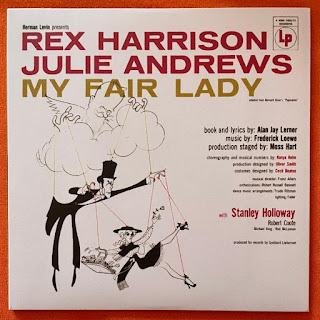
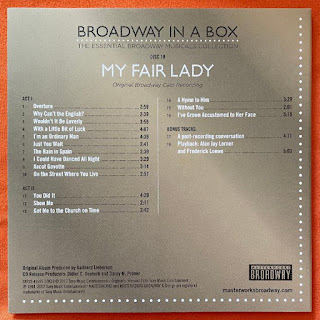
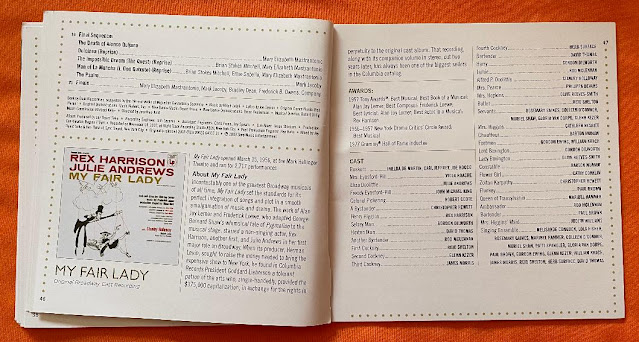
This week’s entry is about the 1956 Original Broadway Cast Recording of My Fair Lady.
One of the earliest recordings in the boxed set, this true classic of a cast album still holds up as a great representation of one of the most successful musicals in Broadway history. The cast is pretty much unimpeachable, the orchestra lavish, and the sound amazingly good (it’s a testament to its quality that I didn’t even notice it was a mono recording as I listened to it).
The two leading singers, of course, give definitive performances. Julie Andrews sings the role of Eliza Doolittle with all of the passion and sweetness that would become her trademark, even if she didn’t convey the character’s pre-transformation earthiness quite as vividly as Lauren Ambrose did in the last revival. Rex Harrison is simply flawless as Henry Higgins, which isn’t surprising since the part was basically written to match his skill-set as an outstanding dramatic actor with limited singing abilities.
The supporting roles are equally well-cast. Robert Coote is bright and engaging as Higgins’ frequent scene partner, Colonel Pickering. Although I don’t care for either of Alfred Doolittle’s big songs in the show, Stanley Holloway certainly nails them, capturing the character’s boisterous and heedless nature. Probably the best of all is John Michael King as Freddy Eynsford-Hill, who delivers a beautiful version of my favorite song from the show, “On the Street Where You Live.”
The CD is generously filled out with two five-minute interviews conducted by Columbia Records president and LP pioneer Goddard Lieberson. The first was conducted after the 14-plus-hour recording session for the cast album. Asked by Lieberson which is their favorite song, Harrison answers “I’m Just an Ordinary Man”; Andrews says “Just You Wait”; and lyricist Alan Jay Lerner quips “Oh, What a Beautiful Mornin’.” Andrews interestingly notes that the recording session was the first time she really noticed the show’s intricate orchestrations, which are apparently difficult to hear on stage. (The interview, it must be said, is marred by an unfortunate joke from the host, about which I won’t go into additional detail.)
In the second bonus interview, Lieberson asks Lerner and composer Frederick Loewe about their creative process. They note their early difficulties in finding a title for the show, and especially in casting the role of Higgins; the latter problem was resolved by their decision to write it as a sing-speech role, thus converting a casting quandary into a writing challenge more under their control. Of their general approach to songwriting, Lerner says that he first conceives the title of a song, which Loewe then sets to music before they collaborate on the rest of the song. To illustrate the process, they discuss and then perform together “If Ever I Would Leave You” from their work-in-progress at the time, Camelot.
Next up is the 1979 Broadway Revival Recording of Oklahoma!
Thanks, Mike! Those interviews sound delightful. -- Jeff
Wednesday, May 5, 2021
At This Theater: The Vivian Beaumont Theater at Lincoln Center


.jpeg)


.jpeg)

.jpeg)

.jpeg)


.jpeg)
.jpeg)


.jpg)
.jpg)
.jpg)
.jpg)