Showing posts with label Broadway in a Box. Show all posts

Tuesday, March 22, 2022

Broadway in a Box CD Review: West Side Story (1957 OBCR)

At Christmas a few years ago, Jeff gave me a copy of Broadway in a Box: The Essential Broadway Musicals Collection. He has now given me the opportunity to use his blog to share my impressions of each of the 25 cast recordings contained in the set, in alphabetical order. 

This week’s entry is about the 1957 Original Broadway Cast Recording of West Side Story.


Broadway in a Box CD Review:
West Side Story (1957 OBCR)

It’s difficult to listen to this original recording without making comparisons to subsequent versions that I’ve seen and heard: the classic 1961 movie; the great-but-not-perfect 2009 Broadway revival; the super-heated, incredibly moving 2020 Broadway revival; and of course the 2021 movie, which (like many of you, I’m sure) I’ve watched multiple times. I’m happy to report that the original holds up very well, and if it won’t necessarily become my go-to recording of the show, it boasts a couple of unique virtues that make it well worth revisiting.


The talents of the legendary original cast definitely shine through on this recording. Chita Rivera’s torrid performance as Anita set a very high bar for all who followed (thank goodness that list includes the likes of Rita Moreno, Karen Olivo, and Ariana DeBose). The thing that really sets this recording apart, though, is the definitive performance of Larry Kert as Tony. With the passionate people who surround Tony in the show, and with the deliberately introspective music Tony is given in this score, it can be a challenge for an actor to really make a mark in this role, but Kert’s singing has an intensity and elegance to it that is unmatched in any subsequent version I’m familiar with.


In terms of the content of the CD, I was struck by two differences between this original version and the more recent and familiar stage and screen versions. This earliest iteration of “America,” of course, only features the Puerto Rican women, and that makes it seem less tense and dramatic than the movie version (now also used in stage productions) that pits Bernardo directly against Anita in a battle for the soul of their community. On the other hand, it was lovely to hear “Somewhere” performed in its original form and setting, as the centerpiece of the second-act ballet. It’s been a long while since I’ve heard the few jagged lines sung by Tony at the start of the ballet, and it was jarring in all the right ways.


The sound quality of this recording, from the early stereo era, is quite good, with a nice balance between orchestra and singers and a wide dynamic range. I’m always surprised, given how stacked with music this show seems to be when seen in full, that the entire score fits comfortably on one disc, with few noticeable cuts. In this case, there’s even room for Symphonic Dances, a beautiful twenty-minute suite of music from the show, performed by Leonard Bernstein’s New York Philharmonic Orchestra.


The inclusion of that particular bonus material highlights one inevitable drawback of this original cast recording: orchestra size. When it comes to the score of West Side Story, bigger is better, and even a large Broadway orchestra is no match for something like the New York Philharmonic, which can also be heard on the recent film soundtrack. 


Tuesday, March 15, 2022

Broadway in a Box CD Review: Sweeney Todd - Highlights (1979 OBCR)

At Christmas a few years ago, Jeff gave me a copy of Broadway in a Box: The Essential Broadway Musicals Collection. He has now given me the opportunity to use his blog to share my impressions of each of the 25 cast recordings contained in the set, in alphabetical order. 


This week’s entry is about the 1979 Original Broadway Cast Recording (highlights) of Sweeney Todd.


Broadway in a Box CD Review:

Sweeney Todd (Highlights) 1979 OBCR


This is another one of those recordings that has been so familiar to me, for so long, that it’s hard to hear it with fresh ears. Accordingly, I’ll spend most of my blog space discussing the status of this CD as a “highlights” recording. Suffice it to say that, after seeing and hearing many versions of this singular and stunning piece of musical theater, the original is still probably the best.


The cast is, of course, stellar from top to bottom. Needless to say, no one will ever top the delicious humor and desperation conveyed in every moment of Angela Lansbury’s performance as Mrs. Lovett. In the title role, I’ve probably heard some actor-singers who lean more dramatically into the bitterness of this character in songs like “Epiphany” - and I’ve heard opera singers perform with greater technical prowess - but Len Cariou’s stoic approach stands the test of time. 


Inevitably, one of my biggest curiosities about this CD was what would be included and what would be cut from the full two-disc recording. Given the completeness of the full version, and the airtight musical integration of the score, the producers surely had to make some difficult choices. Understandably, almost all of Todd’s and Lovett’s material was kept at the expense of some of the secondary characters. Overall, the highlights recording preserves the smooth flow of the score, with little sense of discontinuity; in that respect, I can’t really fault the choices that were made (though I will express my disagreement on one or two things).


The main songs (or sections of songs) that were omitted from the highlights recording include:


  • “Poor Thing”

  • “Green Finch and Linnet Bird” and “Ah, Miss”

  • “Johanna (Mea Culpa)” (sung by the Judge, which I believe was also cut from the original production)

  • “Pirelli’s Miracle Elixir” and “The Contest”

  • “Parlor Songs” (probably the easiest decision to cut)

  • The Wigmaker Sequence/"The Letter"

  • the “City on Fire” section of the Final Sequence


On the other hand, these sections were included but strike me as very much on the bubble:


  • two first-act sections of “The Ballad of Sweeney Todd”

  • “Ladies in Their Sensitivities”

  • all of the music with Sweeney and Judge Turpin leading up to “Pretty Women”


I think it’s likely that “Ladies in Their Sensitivities” would have been cut if it were at all possible, but was kept to avoid leaving a gaping hole between the two halves of “Kiss Me.” If I had been in charge, I think I would have cut the “Ballad” sections and the lead-in to “Pretty Women” in favor of either “Green Finch and Linnet Bird” or “Pirelli’s Miracle Elixir.”


The recording itself is top-notch, and I’m sure the full recording was a shoo-in for the cast album Grammy Award that year. This is probably a feature rather than a bug, but I found myself frequently adjusting the volume while listening to this CD; if the sound level is comfortable for listening to “The Barber and His Wife” or “My Friends,” it will make the whole house shake when you get to the choral sections of the “Ballad” or the end of “Kiss Me.” In my experience cast recordings typically even things out a bit, with these kinds of dynamic extremes more typical of classical recordings; but that’s probably appropriate for this particular score. 


The next (and final) CD in the box set is the Original Broadway Cast Recording of West Side Story.

Wednesday, March 9, 2022

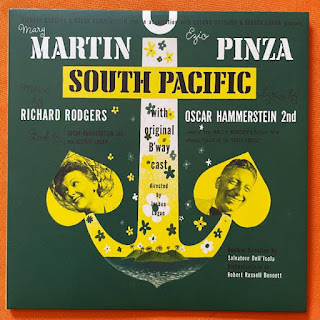
Broadway in a Box CD Review: South Pacific (1949 OBCR)

At Christmas a few years ago, Jeff gave me a copy of Broadway in a Box: The Essential Broadway Musicals Collection. He has now given me the opportunity to use his blog to share my impressions of each of the 25 cast recordings contained in the set, in alphabetical order. 


This week’s entry is about the 1949 Original Broadway Cast Recording of South Pacific.

Broadway in a Box CD Review:

South Pacific (1949 OBCR)


A perennial favorite for its combination of grand entertainment and weighty social issues, this original recording of South Pacific holds up as a very satisfying representation of this seminal Rodgers and Hammerstein score. On balance, I prefer the music and performances from the most recent Lincoln Center revival, but it’s a pretty close call.


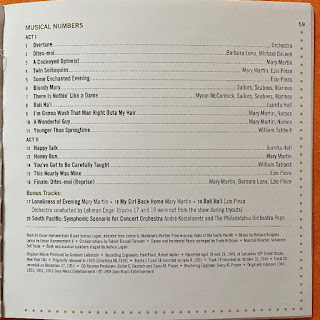
At the center of things, of course, are the characters of Nellie Forbush (sung by Mary Martin) and Emile de Becque (sung by Ezio Pinza). Naturally they both sound wonderful, separately and together (and sort-of together in “Twin Soliloquies”). I slightly prefer both Kelli O’Hara and Paolo Szot from the revival; they have equally amazing voices but bring perhaps a little more personality to their interpretations. However, I can’t imagine that anyone has ever provided a more perfectly sung delivery of “Some Enchanted Evening” than Pinza, who manages to make it sound simultaneously grand and intimate.


Juanita Hall tears it up in the role of Bloody Mary, certainly one of the juicier roles in the musical theater repertory; she oozes warmth and humor, as well as pathos. “Bali Ha’i” is the highlight of the entire recording; with the combination of Hall’s pitch-perfect characterization and one of Rodgers’ most vividly evocative melodies, it’s easy to imagine what it would have been like to be on this special island.


Sharing a stage (or, in this case, a CD) with these three vocal powerhouses, William Tabbert struggles to keep up in the relatively thankless role of Lt. Cable. He does a fine job with one of the show’s most beautiful songs, “Younger Than Springtime,” and does his best with “You’ve Got to Be Carefully Taught” - a song which has always struck me as somewhat underwritten, given its importance to the over-arching theme of the musical.


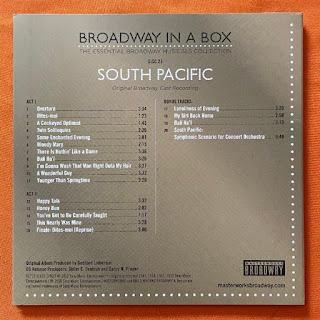
The oldest recording in the box set, this is a mono recording from the early LP era. The sound is still quite clear, with just a little too much echo in the “brassier” sections. The limited recording capacity means that cuts are made to reprises and other music that would probably be included in the era of CDs or digital media, but this CD makes up for it with a generous selection of bonus tracks. Two of these are songs for Nellie, sung by Martin, that were cut from the show in tryouts: “Loneliness of Evening,” a wistful ballad reminiscent of “Hello, Young Lovers,” and the somewhat bluesy “My Girl Back Home.” The third bonus track is Pinza’s version of “Bali Ha’i.” The final track is a very pleasant ten-minute suite of music from the show, conducted by Andre Kostelanetz with the Philadelphia Orchestra Pops.


Next up is the Original Broadway Cast Recording (highlights) of Sweeney Todd.

Wednesday, March 2, 2022

Broadway in a Box CD Review: The Sound of Music (OBCR)

At Christmas a few years ago, Jeff gave me a copy of Broadway in a Box: The Essential Broadway Musicals Collection. He has now given me the opportunity to use his blog to share my impressions of each of the 25 cast recordings contained in the set, in alphabetical order. 


This week’s entry is about the 1959 Original Broadway Cast Recording of The Sound of Music.


BROADWAY IN A BOX CD REVIEW:
The Sound of Music (OBCR)


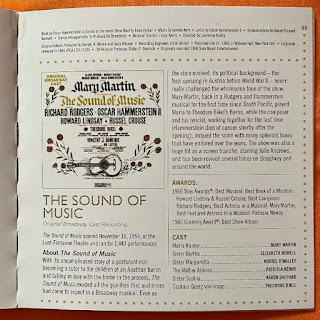
Although this show is not my favorite, and suffers (I think) from over-familiarity, this original recording holds up extremely well as a document of the classic score, with great production values and excellent singers.


Probably very few shows are as dominated by one central character as
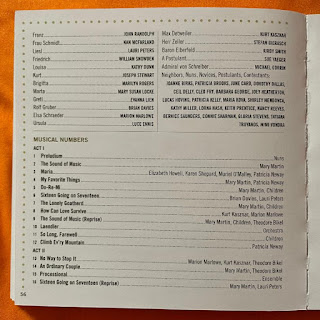
The Sound of Music, and Mary Martin, of course, is more than up to the challenge of bringing Maria to life. She has a deeper and more mature-sounding voice than Julie Andrews does in the film version; she more than makes up for this less youthful presence with a greater passion and dynamic range. Her performance of the title song is full of life and fervor, bordering on the sensual, and she has great rapport with the children in the cast.

Theodore Bikel (Captain Von Trapp), with much more limited (and much less juicy) musical material than Maria, understandably struggles to make his mark next to this force of nature. His “Edelweiss,” however, is sung with a great deal of warmth and nobility.


In the supporting roles, two women stand out. Patricia Neway (Mother Abbess) instills “Climb Ev’ry Mountain,” and its reprise, with a rapturous energy, but is also very down-to-earth in her earlier, more playful songs with Maria and her fellow nuns. More unexpectedly, Marion Marlowe (Elsa Schraeder) really impresses with her two songs, “How Can Love Survive” and “No Way to Stop It.” Her darker voice betrays a sadness that vividly contrasts with Maria’s optimism. With Elsa’s songs cut from the movie to give even more material to Maria, she barely registers in that version, but here she makes a strong impression.


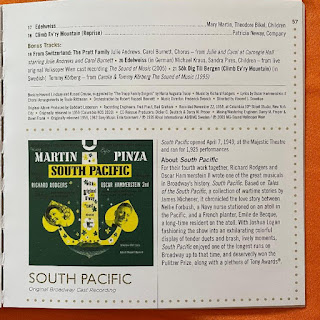
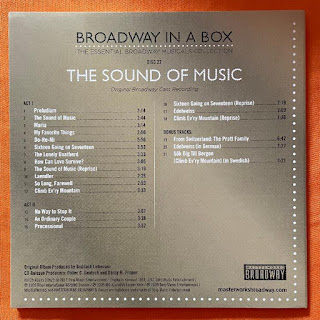
Although this recording is well over six decades old, the sound is terrific, with orchestra, chorus, and soloists all coming through with perfect clarity. The CD is nicely filled out with three bonus tracks. The first, “From Switzerland: The Pratt Family,” is from a Carnegie Hall concert with Julie Andrews and Carol Burnett; it’s an amusing parody of two songs from the show, poking fun of Maria’s most sweetly didactic moments. The other two tracks are lush recordings of “Edelweiss” in German (sung by Michael Kraus and Sandra Pires) and “Climb Ev’ry Mountain” in Swedish (sung by Tommy Körberg, the original Anatoly in Chess).


Next week we stick with Mary Martin in the Original Broadway Cast Recording of South Pacific.


Wednesday, February 23, 2022

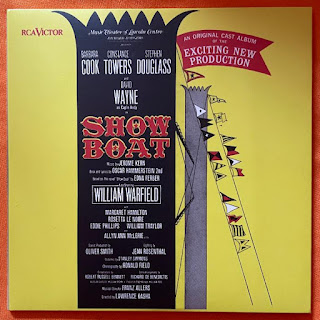
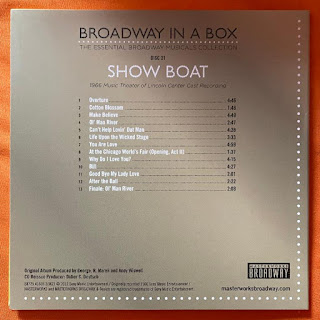
Broadway in a Box CD Review: Show Boat (1966 LCT Cast)

At Christmas a few years ago, Jeff gave me a copy of Broadway in a Box: The Essential Broadway Musicals Collection. He has now given me the opportunity to use his blog to share my impressions of each of the 25 cast recordings contained in the set, in alphabetical order. 

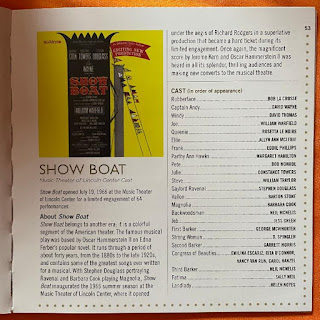
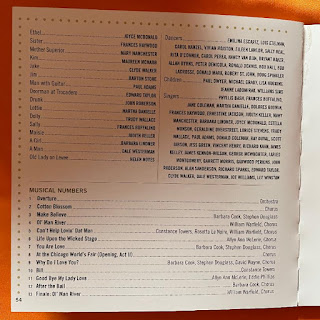
This week’s entry is about the 1966 Music Theater of Lincoln Center Cast Recording of Show Boat.


Broadway in a Box CD Review:
Show Boat (1966 LCT Cast)

Easily the oldest musical (though not the oldest recording) in the set, Show Boat is generally recognized as a turning point in the history of Broadway storytelling, years ahead of its time in its integration of story and song. Unfortunately, despite its Lincoln Center polish and cast full of accomplished singers - including a genuine Broadway legend - this recording is much less than the sum of its parts, and it failed to make much of an impression when I listened to it recently.


The main problem, sad to say, is the singing. Don’t get me wrong - every voice is impressive in its own right, and wouldn’t sound out of place in a legitimate opera house. However, either due to miscasting, poor musical direction, or some combination of both, most of the main singers - Barbara Cook (Magnolia), Stephen Douglass (Gaylord Ravenal), Constance Towers (Julie), and William Warfield (Joe) - come off as just too generic on this recording. For a musical so closely tied to a particular time and place, there is basically no attempt to establish any specificity in the vocal characterizations. 


For a concrete example, I couldn’t help but notice that, even though the famous song is called “Can’t Help Lovin’ Dat Man,” I never heard anything but “that,” with a perfectly enunciated voiced inter-dental fricative. Surely Oscar Hammerstein’s orthography is an implied request to add some local flavor to the articulation of these lyrics, but no attempt whatsoever is made to do this. It’s as if the producer of the recording were determined to stamp out anything approaching authenticity. (One exception is the contribution of Margaret Hamilton, as Parthy Anne Hawkes, whose vivacious musical comedy approach definitely stands out.)


As is the case with other recordings from the Music Theater of Lincoln Center series, technical production values are extremely high. The chorus sounds great, and an enormous orchestra plays Robert Russell Bennett’s original orchestrations. The balance between singers and orchestra is well-executed, and the lyrics are very easy to follow.


Next up is the Original Broadway Cast Recording of The Sound of Music.


Wednesday, February 16, 2022

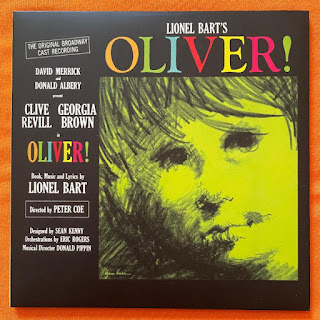
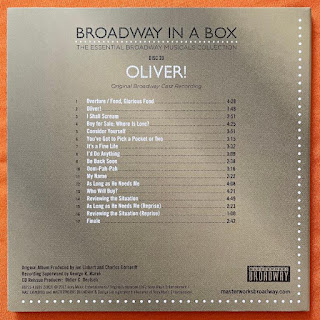
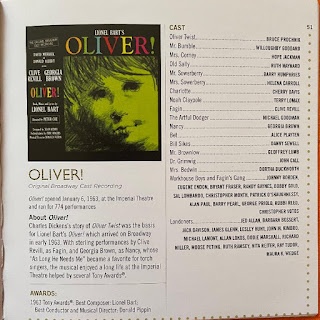
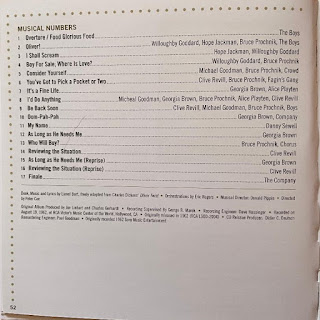
Broadway in a Box CD Review: Oliver! (1962 OBCR)

At Christmas a few years ago, Jeff gave me a copy of Broadway in a Box: The Essential Broadway Musicals Collection. He has now given me the opportunity to use his blog to share my impressions of each of the 25 cast recordings contained in the set, in alphabetical order. 


This week’s entry is about the 1962 Original Broadway Cast Recording of Oliver!


Broadway in a Box CD Review:
Oliver! (1962 Original Broadway Cast)

Oliver! is a bit of an outlier in this set, being the only show written by a non-American (native-born or naturalized), Englishman Lionel Bart. It also happens to be the first musical I participated in when I was in elementary school, as a stage manager for a severely truncated and almost certainly unlicensed performance in a school basement. While the show will never be among my favorites, and the recording itself has a few issues, this was a nice reintroduction to the score.


This is a true ensemble show, and its success depends critically on the chemistry among those playing its rich set of characters; in this respect, this recording is generally satisfying. Clive Revill (Fagin) is a near-constant presence, providing cohesion to the show with his authoritative but sensitive performance. The two main children on the recording, Michael Goodman (Artful Dodger) and Bruce Prochnik (Oliver), could not be more different in voice and temperament, but both are effective and even “cute” without being cloying. Among the larger roles, the only real disappointment is Danny Sewell (Bill Sikes); his big solo, “My Name,” lacks the sense of true menace necessary to distinguish him from a run-of-the-mill bad guy like Mr. Bumble (a too-similar-sounding Willoughby Goddard). (Apparently, this recording was made while the show was on tour months before reaching Broadway, which explains why the OBC Artful Dodger, Tony nominee Davy Jones, does not appear on this CD.)


The standout performance on this recording, hands down, belongs to Georgia Brown (Nancy). Her shattering torch song, “As Long As He Needs Me,” reaches astonishing heights of virtuoso singing and real pathos. She also is very charming in conveying Nancy’s rapport with the Artful Dodger and other ruffians in “I’d Do Anything” (currently famous for helping to pitch pet supplies) and “Oom-Pah-Pah.”


The backbone of the score consists of a series of songs for various combinations of soloists and chorus, including the title song, “Consider Yourself,” “You’ve Got to Pick a Pocket or Two,” and “Be Back Soon.” Even if the composer/lyricist might have gone to the well too many times with this type of song, their realization here is mostly successful. The voices contrast nicely with each other, and the characterizations are vivid enough that, even if the listener has forgotten the details of the story (as I admit that I have), the relationships among the major players are quite clear. 


My favorite song in the show, however, is “Who Will Buy?” Built around a complex and chilling vocal interplay among Oliver and a chorus of street vendors, it has a vaguely modernist feel to it that definitely stands out from the texture of the rest of the score. I can’t really think of anything quite like it from other musicals; the closest thing that comes to mind, oddly enough, is “Falling,” a simpler and shorter (but equally weird) song from Aspects of Love.


The CD leaves something to be desired in terms of recording quality; parts of it sound as if it were recorded in a cave, with lots of echo muddying things up. As a result, the orchestra and very frequent choral sections are sometimes not very clear, and the lyrics can be hard to follow, though it helps that they’re often repeated several times. Though this is one of the older recordings in the set, I can’t really blame its issues on that: How to Succeed was even older, and its sound was among the best in the box set.


Next up is the 1966 Music Theater of Lincoln Center Cast Recording of Show Boat.


Tuesday, February 8, 2022

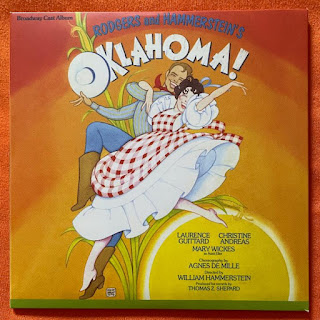
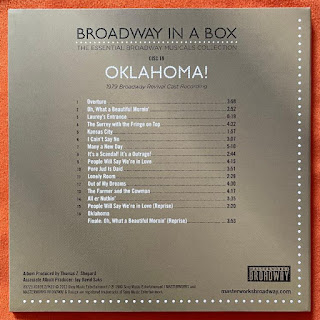
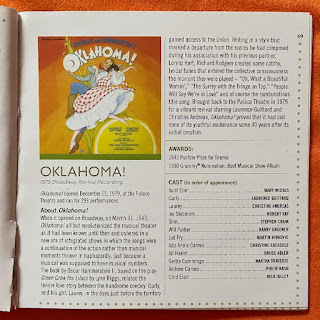
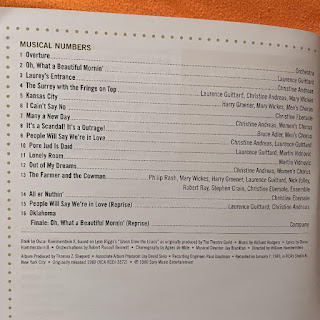
Broadway in a Box CD Review: Oklahoma! (1979 Revival Cast)

At Christmas a few years ago, Jeff gave me a copy of Broadway in a Box: The Essential Broadway Musicals Collection. He has now given me the opportunity to use his blog to share my impressions of each of the 25 cast recordings contained in the set, in alphabetical order. 


This week’s entry is about the 1979 Broadway Revival Recording of Oklahoma!


Broadway in a Box CD Review:
Oklahoma! (1979 Broadway Revival Cast)

Considering the pivotal position of Oklahoma! in the history of musical theater, I’m embarrassed to admit that I had little familiarity with it prior to seeing Daniel Fish’s recent Broadway re-imagining of the show. That version, intimate in scale and designed to highlight the show’s darker themes, is a far cry from this very traditional-sounding revival cast recording. This will never be my favorite Rodgers and Hammerstein title, but this recording is a good record of how the show was originally intended to sound; most of its individual elements are expertly realized, even if technical competence is given priority here over personality and “local flavor.”


This is especially true of the four performers in the show’s central dramatic roles: Laurence Guittard (Curly), Christine Andreas (Laurey), Martin Vidnovic (Jud), and Mary Wickes (Aunt Eller). All are extremely capable singers in the traditional Broadway style, but they come off as rather generic on this recording. (I doubt the CD would sound all that much different to me if each pair of men and women switched places.) An R&H master like Kelli O’Hara manages to be both technically perfect and highly individual in her interpretations; this quartet manages only the former. That’s still a significant accomplishment given the challenging material, but in this version these characters could just as well be from California! or Illinois!


We do get more variety from the actors performing in the supporting roles. In particular, Harry Groener (Will Parker), even if his singing is a little nasal for my taste, makes a strong impression with his version of “Kansas City.” And Christine Ebersole’s performance as Ado is the highlight of the recording: she really does achieve an effective marriage of beautiful singing and vivid characterization. 


The recording itself is of a very high quality. Even in the choral sections, all lyrics are clear, and the chorus sounds terrific, as does the large orchestra playing Robert Russell Bennett’s original arrangements.


Next up is the Original Broadway Cast Recording of another show ending in an exclamation point: Oliver!

Thursday, February 3, 2022

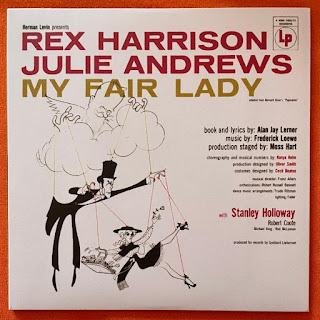
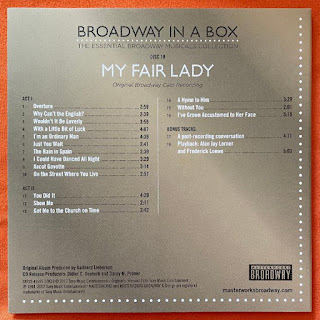
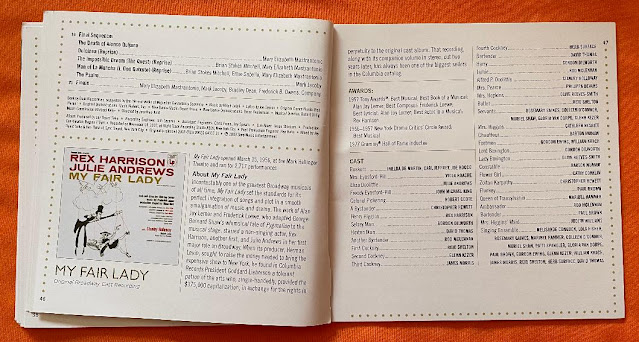
Broadway in a Box CD Review: My Fair Lady (1956 OBCR)

At Christmas a few years ago, Jeff gave me a copy of Broadway in a Box: The Essential Broadway Musicals Collection. He has now given me the opportunity to use his blog to share my impressions of each of the 25 cast recordings contained in the set, in alphabetical order. 

This week’s entry is about the 1956 Original Broadway Cast Recording of My Fair Lady.

Broadway in a Box CD Review:
My Fair Lady (1956 OBCR)

One of the earliest recordings in the boxed set, this true classic of a cast album still holds up as a great representation of one of the most successful musicals in Broadway history. The cast is pretty much unimpeachable, the orchestra lavish, and the sound amazingly good (it’s a testament to its quality that I didn’t even notice it was a mono recording as I listened to it). 


The two leading singers, of course, give definitive performances. Julie Andrews sings the role of Eliza Doolittle with all of the passion and sweetness that would become her trademark, even if she didn’t convey the character’s pre-transformation earthiness quite as vividly as Lauren Ambrose did in the last revival. Rex Harrison is simply flawless as Henry Higgins, which isn’t surprising since the part was basically written to match his skill-set as an outstanding dramatic actor with limited singing abilities.

The supporting roles are equally well-cast. Robert Coote is bright and engaging as Higgins’ frequent scene partner, Colonel Pickering. Although I don’t care for either of Alfred Doolittle’s big songs in the show, Stanley Holloway certainly nails them, capturing the character’s boisterous and heedless nature. Probably the best of all is John Michael King as Freddy Eynsford-Hill, who delivers a beautiful version of my favorite song from the show, “On the Street Where You Live.”


The CD is generously filled out with two five-minute interviews conducted by Columbia Records president and LP pioneer Goddard Lieberson. The first was conducted after the 14-plus-hour recording session for the cast album. Asked by Lieberson which is their favorite song, Harrison answers “I’m Just an Ordinary Man”; Andrews says “Just You Wait”; and lyricist Alan Jay Lerner quips “Oh, What a Beautiful Mornin’.” Andrews interestingly notes that the recording session was the first time she really noticed the show’s intricate orchestrations, which are apparently difficult to hear on stage. (The interview, it must be said, is marred by an unfortunate joke from the host, about which I won’t go into additional detail.)


In the second bonus interview, Lieberson asks Lerner and composer Frederick Loewe about their creative process. They note their early difficulties in finding a title for the show, and especially in casting the role of Higgins; the latter problem was resolved by their decision to write it as a sing-speech role, thus converting a casting quandary into a writing challenge more under their control. Of their general approach to songwriting, Lerner says that he first conceives the title of a song, which Loewe then sets to music before they collaborate on the rest of the song. To illustrate the process, they discuss and then perform together “If Ever I Would Leave You” from their work-in-progress at the time, Camelot.


Next up is the 1979 Broadway Revival Recording of Oklahoma!


Thanks, Mike! Those interviews sound delightful. -- Jeff


Friday, January 28, 2022

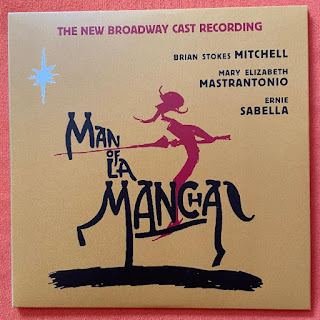
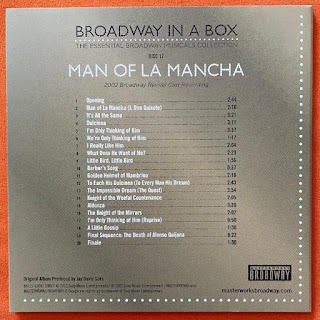
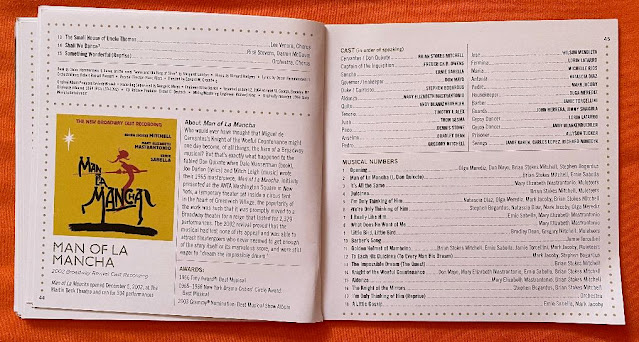
Broadway In A Box CD Review: Man of La Mancha (2002 Revival Cast)

At Christmas a few years ago, Jeff gave me a copy of Broadway in a Box: The Essential Broadway Musicals Collection. He has now given me the opportunity to use his blog to share my impressions of each of the 25 cast recordings contained in the set, in alphabetical order. 


This week’s entry is about the 2002 Broadway Revival Cast Recording of Man of La Mancha.


Broadway in a Box CD Review:
Man of La Mancha (2002 Revival cast)

My previous exposure to this musical has been limited to a Broadway revival from thirty years ago - when I was probably too young to appreciate it - and a very pallid local production, so I was very pleased to rediscover this collection of uniformly beautiful songs with concise, passionate lyrics. This recording, featuring artists who are up to the score’s considerable challenges, is definitely a rewarding musical experience.


I’ve always considered Brian Stokes Mitchell (in the obviously central role of Cervantes/Don Quixote) to have a voice that is powerful but can seem, for lack of a better word, a little distant. This makes him a perfect choice for a larger-than-life character like Quixote. His interpretations of legendary songs like the title song and “The Impossible Dream (The Quest)” are truly intense and thrilling, and even out of dramatic context they still manage to belie the noble self-deception inherent in the character. The overall effect is perfect.


Mary Elizabeth Mastrantonio
is almost as strong as Aldonza, with a voice that is lovely and full of character. Only once or twice, as in the final note of “It’s All the Same,” did I get the impression that her voice may be just slightly too low to be an ideal fit for the score. I would also add that, at least in her singing, she doesn’t draw quite as abrupt a distinction between fantasy Aldonza and prostitute Aldonza as Sheena Easton did back in 1992. But this is still an interesting and beautiful vocal performance, and these quibbles didn’t really do any harm.


The rest of the casting is equally solid and vocally quite varied, which is always a big asset when one is following a story from a cast recording. Ernie Sabella (Sancho) has a wonderfully rich comic singing voic; it was delightfully obvious that this is one of those roles that in retrospect we would call “queer-coded.” Natascia Diaz (Antonia) has a darker and deeper voice that contrasts nicely with Mastrantonio’s. Similarly, Mark Jacoby’s (Padre) simple but gorgeous delivery of “To Each His Dulcinea” makes for a nice complement to Mitchell’s more stylized voice.


The quality of the recording itself is outstanding. Every word from these intricate lyrics is crystal clear, even to someone like me who hasn’t heard them very often or very recently. The balance between the soloists, the chorus, and the musicians is perfect throughout; with the orchestra in particular, everything is vibrant: tutti outbursts (in the title song), tender musical moments (in the finale), little woodwind details (like the clarinets in “I’m Only Thinking of Him”), and of course the guitar that gives the score so much of its particular character. I would certainly be interested in seeing and hearing these songs on stage once again.


Next up is the Original Broadway Cast Recording of My Fair Lady. 

Thanks for such a thoughtful review, Mike! Fun fact: Man of La Mancha was my first musical. My Fair Lady was my second! Looking forward to your thoughts on that classic. --Jeff

Tuesday, January 18, 2022

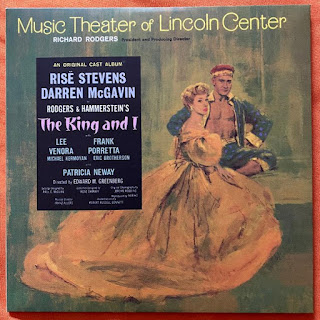
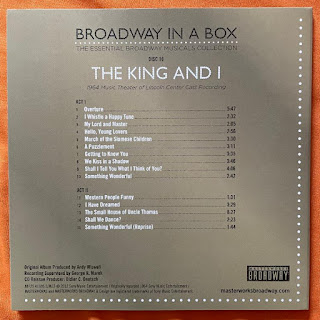
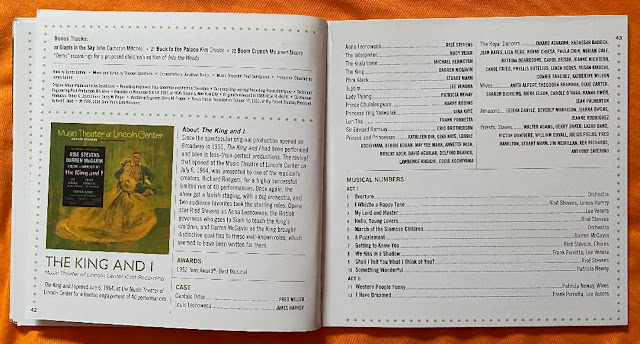
Broadway in a Box CD Review: The King and I (1964 Lincoln Center Theater Cast)

At Christmas a few years ago, Jeff gave me a copy of Broadway in a Box: The Essential Broadway Musicals Collection. He has now given me the opportunity to use his blog to share my impressions of each of the 25 cast recordings contained in the set, in alphabetical order. 


This week’s entry is about the 1964 Music Theater of Lincoln Center Cast Recording of The King and I.


Broadway in a Box CD Review:
The King and I (1964 LCT Cast)
 

Some shows, like How to Succeed… from a couple of weeks ago, lend themselves to cast recordings that stand on their own in terms of musical storytelling. I don’t think The King and I is one of those shows, and this competent but undistinguished Lincoln Center recording neither adds nor detracts from that impression.


Don’t get me wrong - this score is full of great songs, some beautiful, some quite fun, but most of them not very dramatic, in the sense of building a story and moving it forward. The first act, especially, is dominated by lush but slow-moving introspective ballads (one of which, “Hello, Young Lovers,” is one of my two favorite Rodgers and Hammerstein songs), plus a similarly textured love duet. This general homogeneity is not really a problem in the context of the larger story we’d see on stage, but it doesn’t make for a particularly exciting cast recording. The second act is much more dynamic, but also rather short on this CD, which omits several reprises of songs from the first act.


This recording boasts a huge and talented Lincoln Center chorus and orchestra - I could listen to the amazing overture all day long. Otherwise, most of the individual elements are polished but not particularly remarkable. This applies, first and foremost, to operatic soprano Risë Stevens (Anna Leonowens), who of course has the vocal abilities necessary to tackle this score, but does not add much in the way of personality. She’s at her most interesting when she attempts an early-Disney-princess sort of chirpiness in her jauntier numbers, like “Whistle a Happy Tune.”


Darren McGavin is similarly middle-of-the-road as the King, with an appropriately broad set of vocal gesticulations, but otherwise without much sense of really inhabiting the character; his accent is vague and sporadic. Of course, it’s hard to listen to a performance like this in 2022 without there being some kind of cringe factor at the lack of authenticity from both the writers and the performer. Along those same lines, I was slightly bothered by the fact that the chorus of the King’s wives and children would sing using the Queen’s English (“Getting to Know You”) or stereotypically strained syntax (“The Small House of Uncle Thomas”), depending on the momentary requirements of the story.


Despite my lack of enthusiasm for this recording, there were several highlights. The best vocal performances belong to Lee Venora (Tuptim) and Frank Porretta (Lun Tha), who deliver passionate versions of their two duets, “We Kiss in a Shadow” and “I Have Dreamed.” The recording also comes alive in the first part of the second act, beginning with a vivid performance, led by Patricia Neway (Lady Thiang), of the provocative “Western People Funny.” (Do the ironic lyrics here imply that the creators knew that there was something a little peculiar about people like them making a show like this?) Finally, “The Small House of Uncle Thomas,” always a highlight in this score, doesn’t disappoint here (cringe factor notwithstanding).


Next up is the 2002 Broadway Revival Cast Recording of Man of La Mancha.


Thanks for another great write-up. It is always interesting to look back at vintage recordings, consider how they are a product of their time, and to recognize what holds up and what doesn't. Looking forward to next week - Man of La Mancha was the very first show I was ever in! --Jeff


Related Posts Plugin for WordPress, Blogger...