Play It Again:
Oliver!'s "As Long As He Needs Me"
For this new series, Jeff has invited me to choose some classic Broadway show tunes and compare versions of these songs from several different cast recordings. Wherever possible, I’ll link to the songs on YouTube, where I listen to most of them myself.
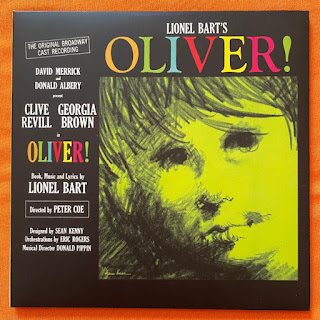
Lionel Bart’s classic Oliver!, though not my favorite score, will always have a place in my heart, as it constituted my first close contact with musical theater. When I was in seventh grade, my school brought in an outside music teacher to lead us in producing a heavily truncated, very sloppy, and almost certainly unlicensed performance of the show, for which I served as a stage manager. As I recall, our version followed the gist first act, but then skipped to the final “Consider Yourself” reprise to give Oliver a happy ending with his new chosen family.
Needless to say, Nancy’s tragic fate at the hands of Bill Sykes did not make the cut, nor did her second-act torch song “As Long As He Needs Me.” Sung at a point in the story where the audience knows more than Nancy does about the danger she’s in, this textbook example of dramatic irony furnishes a great opportunity for a singing actress to exhibit extremes of both pathos and passion. The four recordings considered here demonstrate how four different performers attempted to do just that. Once again, though the melody and lyrics haven’t changed over the decades, these versions display a remarkable variety in vocal style and musical texture.
My overall favorite version is marked with two stars (**); one star (*) is used to indicate that a particular version stands out in terms of singing, orchestra, sound, or other miscellaneous qualities.
ORIGINAL LONDON CAST (1960) - YouTube
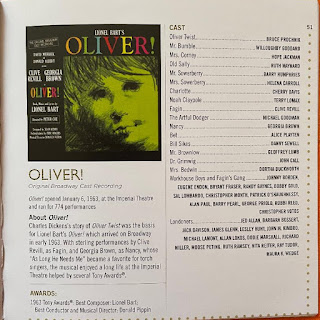
Nancy: Georgia Brown
SINGING: Brown gives a much more straightforward vocal performance than the others, sticking to the written melody and staying on meter throughout the song. Within these confines she does a nice job shaping character with her rather sharp, jabbing delivery of certain lines and her dynamic control, creating dramatic build-ups and releases.
ORCHESTRA: This version features a lovely dissonant introduction and is marked by distinctive, pearly, descending woodwind “puffs” for the duration of the song. The overall sound is the lushest of the four, though it’s not particularly varied in musical quality.
SOUND: The stereo sound is quite good, and there’s a nice layered effect for various parts of the accompaniment, but some details are a bit too quiet and get lost in the mix.
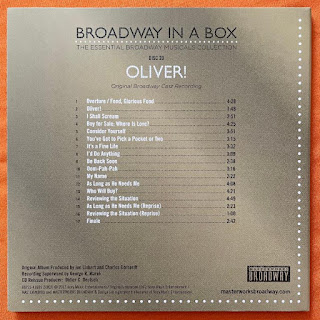
MISCELLANEOUS: The four versions differ markedly in tempo; this one is on the slow side, with the track clocking in at 3:51.
MOTION PICTURE SOUNDTRACK (1968) - YouTube
Nancy: Shani Wallis
SINGING: Wallis’s interpretation is extremely actorly, favoring characterization over vocal perfection. Certain parts are sung in a halting, lachrymose manner; there are quick changes in volume and long, dramatic pauses (listen for both near the lyrics “the way I feel inside”), as well as spoken lines (“he doesn’t say the things he should”) that abruptly give way to soaring melody. It seems a bit over the top to me, but it’s clear from the general feel of the recording that this was largely a directorial choice.
ORCHESTRA: The string-heavy orchestration is rather spare for the first half of the song, matching Wallis’s bare-knuckled delivery, but builds up nicely in the second half. I particularly liked the sound of the late-song bridge (“if you are lonely…”).
SOUND: The sound is atmospheric but a little muddy at times. (To be fair, the YouTube video appears to be a capture from the film rather than a track drawn from the recording, so it’s hard to make direct comparisons with the other three.)
MISCELLANEOUS: The tempo is very, very slow, exacerbated by the singer’s long pauses; the track comes in at a whopping 4:45.
**LONDON REVIVAL CAST (1994) - YouTube
Nancy: Sally Dexter
*SINGING: Striking the perfect balance between Brown’s musical precision and Wallis’s freewheeling laxity, Dexter does a beautiful job creating a vivid character while maintaining high vocal standards. Her very soft, almost catatonic delivery at the beginning creates a sense of something like menace; this gives way to a more demure style that effectively conveys the character’s attempt to hide her fears under the cloak of passionate love.
*ORCHESTRA: I’m not generally a “less is more” person when it comes to orchestrations, but the mantra definitely holds for this recording. The piano begins the song alone and remains prominent throughout, soon to be supplemented with lovely, restrained punctuation from the strings, including some striking string solos. The orchestration builds as the song does, with an especially nice, horn-tinged bridge and the expected stirring finale.
*SOUND: This recording is very clear, with a nice stereo balance. Like many classical recordings and a few other cast recordings (e.g. the original Sweeney Todd), the dynamic range is a little jarring here, requiring some intra-song volume adjustments; but this is a feature rather than a bug, since it accurately captures the build from an eerily quiet beginning to the impassioned ending.
MISCELLANEOUS: These last two versions feature a much brisker pace, which I think works best for this song (this one is 3:16).
LONDON REVIVAL CAST (2009) - YouTube
Nancy: Jodie Prenger
SINGING: Prenger’s approach is similar to Dexter’s, and most of the praise I heaped on the latter applies also to the former, but she’s maybe ten percent less effective. Her rather extreme accent and late-song emotional breakdown disturb the balance just a tiny bit.
ORCHESTRA: The orchestration is again piano-heavy and similar to the 1994 recording, but it’s both fuller and less subtle.
SOUND: The sound is clear, and the balance between singing and accompaniment is quite good; there’s just a little fuzziness in the very loudly performed ending.
*MISCELLANEOUS: This is a live recording, but the performance is excellent, and you wouldn’t know it was live if it weren’t for the applause at the end. Once again, the overall tempo is fast; in this case, a relatively relaxed first half gives way to a more urgent conclusion, a very effective combination. (For the record, this one comes in at 3:08.)