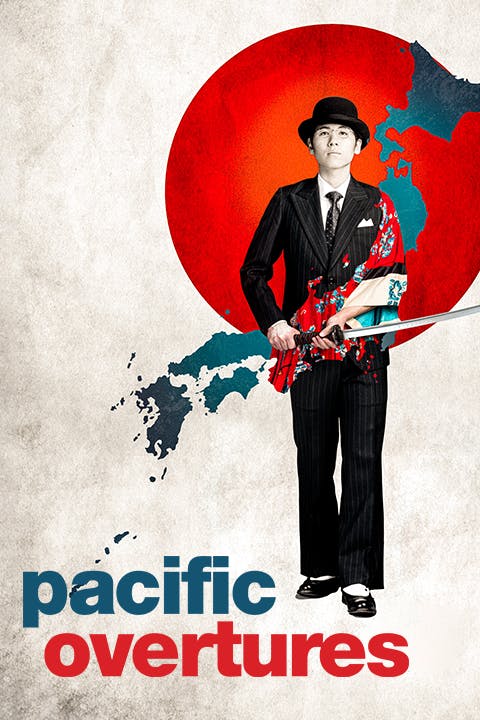
ReDISCoveries: Pacific Overtures
(Original Broadway Cast Recording)
Jeff has kindly invited me to revisit and review some of the older cast recordings in my collection. Every other week or so, I’ll write about a new CD, offering some general impressions followed by my thoughts about each individual song. This week’s entry is about the 1976 Original Broadway Cast Recording of Stephen Sondheim and John Weidman’s Pacific Overtures.
I’ve had the good fortune of seeing three professional productions of this difficult and ambitious show: a raucous, maximalist Japanese production (performed with English supertitles) that was part of the 2002 Kennedy Center Sondheim Celebration; John Doyle’s tight and highly focused 2017 off-Broadway revisal; and Signature Theater’s small-scale but (for me) definitive production from earlier this year, which approached the full original book and score with an appropriately modern sensibility. Though that last one was my favorite, each of these productions had their own tone and style, centering different themes present in the text and the songs.This recording features the music and cast from the original Broadway production, which famously had its own quirky sensibility. Director Hal Prince went all in with his attempt to adhere to kabuki traditions, or more precisely his Western interpretation of them. On disc, this means that the character of the Reciter, in particular, both speaks and sings in a heavily stylized manner (matched by eccentric movements and facial expressions, as seen in the video available on YouTube). All of the characters, including several prominent female roles, are played by men. All of this can take some getting used to, but in the end it works very well as part of the creative trio’s sure and steady vision for the show.
One thing I love about this recording is its large orchestra: 22 in-house musicians augmented by 14 additional players for the recording. While modern revivals have tended to preserve the traditional Japanese instruments but heavily reduce the conventional Broadway-style orchestra, the size of the ensemble on this recording allows for a truly epic sound that is unlikely to be matched by any stage production outside of an opera house. Not only are “Western” songs like “Please Hello” and “Pretty Lady” more fully realized, but we hear exciting orchestral details in “Japanese” songs like “Chrysanthemum Tea” and “Someone in a Tree.”
THE SONGSI use a star (*) to mark the songs I particularly like, and my overall favorite gets two
stars (**).
The Advantages of Floating in the Middle of the Sea: One thing that sets this score apart from other Sondheim shows is its effective use of repetition. In this brisk opening number, the music and the Reciter’s (Mako) lyrical formulas are repeated several times with only slight modifications, a reflection of the unchanging nature of Japanese life before the arrival of American ships. Here, as in a few other songs, the repetition can become slightly monotonous, but that is exactly the point.
**There Is No Other Way: This haunting meditation beautifully captures the anguish of the samurai’s wife as her husband is sent on what she assumes is a suicide mission to confront the American “visitors.” The voices are those of two men observing her desperation (Alvin Ing and Ricardo Tobia), articulating the deliberations of husband and wife. The song begins with some kabuki-esque plucks and thumps to accompany quiet reflective words, but develops organically into some rather grand flourishes from the large string section as a voice asks “is there no other way?” The musical contrast is gorgeous.
Four Black Dragons: This song, sung by the Reciter and a couple of townspeople (Jae Woo Lee and Mark Hsu Syers), vividly expresses the terror of those seeing the foreign “visitors” for the first time. Unfortunately, this is a scene that has been repeated many times, from the era of Western colonialism up to the present day.
*Chrysanthemum Tea: An entire mini-drama in the form of one seven-minute song, “Chrysanthemum Tea” was cut from John Doyle’s one-act version of the show, which focused on the through-story of the two “leading men.” But it’s definitely an amazing thing in its own right, a tour de force for the actor/singer playing the Shogun’s mother (Ing) who narrates a simple yet nuanced story with its own cast of characters. Here again repetition is used to great effect, as the Shogun’s mother tries to coax her son into taking action against a threat that refuses to go away, day after day, before she decides to take more drastic action.
Poems: With its very spare arrangement and typical Sondheim ballad-like melody, this song introduces our protagonists: rapidly-ascending samurai Kayama (Isao Sato) and his assistant Manjiro (Sab Shimono), who has recently returned from an inadvertent stay in America. Each one recites a series of poems to pass the time; Kayama’s are more traditional and emphasize his ties to country and family, while Manjiro jarringly reminisces about his visit to Boston. Their perspectives will shift considerably during the course of the show.
Welcome to Kanagawa: This song presents itself as a fairly standard attempt at comic relief, but for me the jokes just don’t land like they should in such a song. Bawdy as the lyrics seem to want to be, they remain too vague to evoke the kind of images that might make for real humor. Maybe I’ve just never gotten the real intent of this one, but Sondheim has written much funnier songs. (The amazing Ann Harada, however, did her very best to sell it off-Broadway.)
*Someone in a Tree: Many essays and book chapters have been written about this song, so I won’t add much here, other than to defend my assignment of one star rather than two. Even though it’s one of Sondheim’s own favorites - and the quality of its intricate lyrics and brilliant concept are not up for debate - the music itself is standard Sondheim talky-song fare, completely appropriate for the context but not as stirring as other parts of the score.Please Hello: Always a highlight of any physical production, this song (really several songs in one) is the height of comic pastiche. It’s another song that benefits greatly from the expanded orchestra on this recording, allowing orchestrator Jonathan Tunick to fully evoke the sounds of America, the UK, France, Holland, and Russia (as perceived by Japanese characters created by American writers).
A Bowler Hat: Another song where length and repetition reflects the slow but steady passage of time, the simplicity of the lyrics makes for a stark contrast with the verbosity of the Western characters featured in the previous song. A lyric like “I drink much wine” - maximally terse, highly formal, probably not something a native English speaker would say - perfectly captures Kayama’s state of mind and social “progress.”
*Pretty Lady: Befitting its title, this is certainly the prettiest song in the show. Listening to it on a recording, it’s easy to be fooled by its sedate beauty, but those who know the plot are aware that the three British sailors (Patrick Kinser-Lau, Timm Fuji, and Syers) are prepared to take what they want from this pretty lady. The simple but vibrant orchestration makes this one of the musical highlights of the cast album.
Next: Musical and thematic themes from the opening song are revisited here, as the Reciter describes the full effects of the Westernization of Japan, from the 1850s up to the contextual present. The nature of this song implies the need for periodic updates to some of the spoken lines, and it’s interesting to track some of these changes over the past five decades:
This original version emphasizes the economic success of post-war Japan, with wry comments about the eight Toyota dealerships in Detroit and the ubiquity of Japanese-made souvenirs for the U.S. bicentennial celebration.
The 2002 Kennedy Center version included some similar factoids, but also emphasized the assistance offered by Japan in the wake of the previous year’s terrorist attacks on the United States.
John Doyle’s production, which focused on character rather than history, completely excised the topical commentary from “Next.” Though I liked the show a lot, this made the finale seem somewhat rushed and cursory.
This year’s Signature Theater production, occurring at a time when Japan is no longer America’s biggest economic rival, leaned heavily into pop culture trends and late-capitalist malaise.


.jpeg)

.jpeg)
.png)


.jpeg)
.jpeg)