Monday, July 24, 2023

Star-To-Be: Piazza's James D. Gish

🌟Star-To-Be🌟
Piazza's James D. Gish 

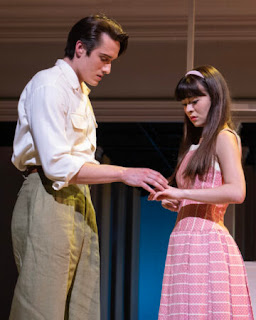
It has been weeks since we basked in the theatrical glow that was Encores' The Light in the Piazza and the stunning performances of Ruthie Ann Miles and company. But it hasn't been far from our minds since. One of the many reasons why it continues to resonate was the utterly charming turn by James D. Gish as Fabrizio. By intermission, we just knew this guy is a Star-To-Be, and not just because of those matinee idol looks, either.


Sure he has a Broadway credit (as one of a long line of Fiyeros in Wicked), a couple of National Tours (Beautiful and Les Miserables) under his belt, and an impressive resume of regional roles. He also has a great career as a vocalist and voice over artist. Gish is also a graduate of ASU's Barrett Honors College with a B.S. in Business Administration (it's good to get an education). With his face on a Hershey bar, maybe he's already a star?


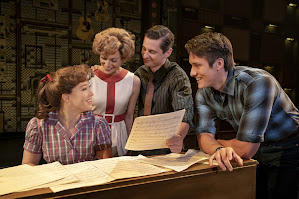
National Tours: Beautiful (far left); Les Miserables (to the left of Eponine)


Regional (clockwise from top left):
Jersey Boys (2nd from left); Newsies;
Bullets Over Broadway (center); The Toxic Avenger

What we see, though, is a future where he is a real above-the-title ticket draw on the Great Bright Way and beyond.

Friday, July 21, 2023

Broadway Games: Characters!

Broadway Games: Characters!

Below are pictures of characters from Broadway musicals from their show's logos, Playbills, or window cards. For each, name the character (not the actor) as fully as you can, and the show they are in. Some show more than one character, so try to name them all!

1 point for the character's first name, 1 point for the character's last name (if there is a known last name), and 1 point for the show title. Good luck!!

EXAMPLE: 


1 point: Annie

1 point: Warbucks

1 point: Annie


1.   2. 
3.    4.    5. 
6.    7. 
 8.     9.

 10.     11. 

 12.     13. 

14.    15. 

BONUS:


Wednesday, July 19, 2023

ReDISCoveries: Myths and Hymns (1999 Off-Broadway Recording)

 ReDISCoveries: Myths and Hymns
(1999 Off-Broadway Recording)

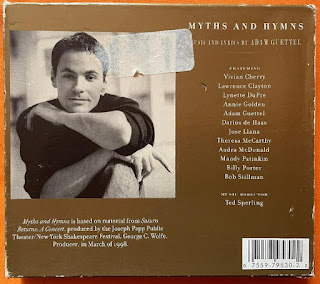
Jeff has kindly invited me to revisit and review some of the older cast recordings in my collection. Every other week or so, I’ll write about a new CD, offering some general impressions followed by my thoughts about each individual song. I continue this week with the 1999 off-Broadway cast recording of Adam Guettel’s Myths and Hymns.


This recording of Adam Guettel’s modern song cycle is perhaps the least familiar one on my CD shelf. I’ve never seen a performance of the work (rather few have had that opportunity!), and before this week I had only given the CD one casual listening since buying a used copy about ten years ago. It’s interesting to approach a score like this with an almost total veil of ignorance about its music and lyrics. This approach is greatly facilitated by the non-narrative nature of the work, since one can appreciate each individual song without trying to figure out a story that connects them.


Myths and Hymns had a very brief run at the Public Theater in 1997 under a title shared by one of its songs, Saturn Returns. This recording features the full cast from that production, along with some performers who had participated in the show’s development. The list includes several Broadway icons (Audra McDonald, Mandy Patinkin, Billy Porter), a couple of fan favorites (Jose Llana, Annie Golden), and the composer/lyricist himself.


The 13-player orchestra is in a sense the complement of the Light in the Piazza ensemble: this one is relatively heavy on winds and percussion and light on string instruments. (Both use a harp, which seems central to the dense musical textures Guettel tends to create.) Playing orchestrations by the late Don Sebesky and Jamie Lawrence, this small group manages to evoke several different musical styles and create a variety of unusual effects.


Although the songs in Myths and Hymns are not connected by an overarching storyline, they form a cohesive unit on the basis of a shared theme, suggested by the name of the work. In a note included in the libretto for the recording, Guettel writes that he was inspired by books on mythology as well as a hymnal he found in a used book shop. He discovered that “they have a lot in common - a desire to transcend earthly bounds, to bond with something or someone greater.” While I can’t say that these songs affected me quite as deeply as this lofty description might suggest, I did find listening to this score to be an intense and unusual experience, often quite beautiful, constantly changing, and never dull.


THE SONGS


I use a star (*) to mark the songs I particularly like, and my overall favorite gets two stars (**). The main performer(s) for each song are indicated in parentheses.


*Children of the Heavenly King (Theresa McCarthy): We’re thrown immediately into the depths of post-Sondheim modernism with this gentle but highly dissonant introduction to the themes of the song cycle. The singing here is beautiful and ethereal, comfortingly grounded in musical theater rather than opera. The first verse of this is accompanied by bare piano chords, while the second verse has a more piquant woodwind arrangement.


At the Sounding (Vivian Cherry, Darius de Haas, Llana, McCarthy): This strident fanfare of a song features some glorious vocal arrangements for the quartet of singers, who call us together to hear the stories that form the remainder of the work. It’s pretty amazing that this orchestra can produce such brash and brassy sounds (the only actual brass instrument is a single trumpet). 


Saturn Returns (Guettel): The jarring piano chords are back, as the soloist sings at first of vague memories and longings. Pretty soon this develops into a full-fledged cry for something transcendent, as he is joined by the full orchestra and vocal ensemble, pleading: “Oh, get me up like Icarus/And give me wings like Pegasus/Just get me out and get me high!”


Icarus (Guettel, Lawrence Clayton): We’re on more solid Broadway-like ground with this song, a very funky take on the famous mythological episode. Guettel serves as narrator, with Clayton interjecting his paternal warnings to Icarus. Eventually the rest of the ensemble joins in as the song reaches its rather psychedelic climax.


Migratory V (McCarthy): After a long and plaintive oboe solo, the singer embarks on a tranquil meditation on human achievement, concluding that only by striving together can we reach our potential: “A migratory V/How wonderful if that’s what God could see.” 


Pegasus (Porter, Lynette DuPre, McDonald): This guitar-driven folk-like song is a three-way dialogue among Pegasus (DuPre), her rider (Porter), and the gadfly that bit her, causing her to throw him off (McDonald). The focus here is on the clever, fast-past lyrics, as when the gadfly observes: “They seize upon the incident/Look for implications/When it was only Zeus again/Venting his frustrations.”


Link (Cherry, de Haas, Annie Golden, Llana, McCarthy, Bob Stillman): This brief track serves its literal purpose, consisting of some vocal murmuring to transition into the next song.


Hero and Leander (Guettel): In this comparatively conventional love song, the narrator compares his own new-found love to that of the legendary couple. In the tradition of similar romantic pop ballads, the accompaniment builds from a solo piano to full orchestral climax, before receding again for the final few measures.


*Sisyphus (Patinkin): This song, with a delivery reminiscent of Patinkin’s vocal antics in “The Day Off” from Sunday in the Park With George, is about as close as the score gets to genuine musical comedy. The title character vents his famous frustrations with increasing ferocity as the vocal ensemble interrupts with unhelpful comments, punctuated by loud jabs from the orchestra. While this song isn’t as musically interesting as others in the score, it’s pretty fun, and an effective way to tell this story.


**Come to Jesus (McCarthy, Guettel): In this six-minute song - somehow both the longest and most concise in the show - a young couple, Matthew and Emily, exchange letters, the orchestra recapitulating the music from the very beginning of the score. She, writing from a doctor’s office, wonders if the couple has made the right decision about ending her pregnancy, and implores him not to let the experience tear them apart. He, writing from an airport, replies that they are each alone now, and prays for forgiveness. Much of the song is taken up by a jagged and expansive setting of a traditional religious text, allowing each of them to express their hopes and their despairs without having to come up with words to pin them down. The overall effect is of a complete mini-drama unfolding over the course of a simple exchange of letters.


How Can I Lose You? (Golden): This song, a fast but amiable waltz, drips pleasantly of Sondheim pastiche, evoking especially the melody and rhythm of “Agony” from Into the Woods, combined with the tone and theme of “Losing My Mind” from Follies. I know I’ve invoked Sondheim several times in this write-up, but it’s hard to avoid hearing his influence in this score - and particularly in this song, which seems like a deliberate homage to his style.


There’s a Shout (Cherry): This song is a straightforward, full-throated Gospel pastiche, in both music and lyrics. It’s not a song I’d probably listen to on its own, but it does make for a pleasant detour in the context of this generally heavy score.


*Awaiting You (Porter): This song, featuring the score’s most enigmatic lyrics, seems to be a meditation on the contradictions of life on earth, simultaneously a great gift and a series of losses and frustrated hopes. Regardless of its meaning, it features a young Porter already exhibiting his unique and very theatrical vocal talents. Although I think Guettel might go to the well a bit too often in this score with songs that follow the quiet-loud-suddenly-quiet-again format, this is probably the best example of that type.


The Great Highway (McCarthy, de Haas): This is another transitional passage, consisting of a rather desperate flow of “oohs” and “aahs” from the singers (wordless vocal lines seem to be a Guettel trademark), with a slightly nightmarish orchestral accompaniment.


There’s a Land (Guettel): The mood is more celebratory in this jaunty song, with the singers imagining a land “of pure delight,” perhaps invisible but not too far off or difficult to get to. The texture of this song is striking, with sudden shifts in tempo, but a little disorienting.


Saturn Returns (reprise) (Guettel): This is not a recapitulation but an “update” to the earlier version of the song. Where the singer previously focused on the pain of longing for something beyond the ordinary, here, in the work’s finale, the singer acknowledges that it is precisely this emptiness that can be our best guide to pursuing the things that we really need.


Next time I’ll return to more familiar territory: the 2006 Original Broadway Cast Recording of Spring Awakening. 


Friday, July 7, 2023

Broadway Games: Anagrams - People Edition

Last week's game was such a hit, we thought we'd try another round of Broadway Anagrams. Instead of show titles, this week is all about show people!

Broadway Games:
Anagrams - People Edition


Since last week was kind of challenging, we are mixing it up by adding a new level to the game. Clues to what the anagrams are are in the right column. Match the clue to the anagram in the left column. Good luck!

1. Joyous Client                        A. She’s played two real-life people on Broadway.

2. He Hires Jargon                   B. We’ve been crazy for this choreographer for years.

3. Rude And Drawn                  C. He sings “Music, Money, Love” in New York, New York.

4. Wet Elf Boys                        D. They just won a Tony Award.

5. Nylon Actor                         E. She's a Tony nominee for From The North Country.

6. Sun Tan Morass                 F. Her look back is now theatrical legend.

7. A Medical Domain               G. He plays Arthur’s rival for Guenevere’s affections.

8. An Odd Coin Jar                 H. He’s the hunky Beau in Shucked.

9. Mean Arm Whining             I. She’s the “other” Anne Hathaway.

10. Mushier Tan Line              J. This young man earned a Tony nod for his debut.


STOP SCROLLING NOW UNLESS YOU ARE READY TO SEE THE ANSWERS!


1. Justin Cooley J                            6. Susan Stroman B

2. J. Harrison Ghee D                     7. Micaela Diamond A

3. Andrew Durand H                        8. Jordan Donica D

4. Betsy Wolfe I                                9. Mare Winningham E

5. Colton Ryan C                            10. Ruthie Ann Miles F    

Thursday, July 6, 2023

Opinion: Is Fun Enough For a Good Broadway Musical?

Opinion: 
Is Fun Enough For a 
Good Broadway Musical?


The reviews I post are, I think, well-considered and honest. And I really enjoy getting your feedback. My favorite type of feedback might surprise you: when readers don't agree with me. Well, I'll be more specific. Even when readers don't agree with me, they are respectful and try to understand my views. Those are the kind I love, a dialog between true fans of the theater where differences of opinion are opportunities to learn, grow, and see things in a new way.

Then there are the ones where people are, well, mean. Accusatory. Insulting. It usually happens when I don't like a show. "You just didn't get it." "You like everything, so why are you dumping on this?" It's just as true when I like something where the court of social media has collectively turned up its nose at a show. You should have seen some of the emails I got when I liked Bad Cinderella.

But this time around, I really didn't like Once Upon a One More Time. Hell hath no fury like a Britney fan. Oh I heard it all. "You have no taste." "It was perfect. You must be old." (For the record, I've enjoyed Ms. Spears since her earliest hits when they actually came out, which does make me old, I guess.) But the most grating response, that I heard from multiple people, including a "legit critic" from a popular Broadway website, is that I don't like "fun" musicals. What??!!

Let me respond by saying when I see a new show, I assume I'll have fun. Maybe I need to explain this. For me, all musicals have the potential to be fun. Fun means that I was entertained. Maybe I laughed a lot. Maybe I cried. Maybe I was dazzled by big, splashy dance numbers, stunning sets and costumes. Or maybe I was awed by a sparse, but packed with theatricality, staging. My point is that Sondheim can be fun. Rogers and Hammerstein can be fun. An ABBA musical can be fun. So can a Britney Spears musical.


But is "fun" alone enough to make me love a show? Sure. Let's be honest, Mamma Mia and Moulin Rouge! are really meant to be fun diversions, and they are wildly successful musicals. Head Over Heels, the same thing, but not as successful. I loved all three, all for a variety of reasons, including the fact that they are simply fun. But they are all also very well staged. All are clever and even thought provoking. Their stories are simple but compelling, and their characters have depth, even in their silliest moments. None of these criteria are (in my opinion) in One More Time.

Although all of these examples are jukebox musicals - which seem to bring out the best and worst in theater fans - there are plenty of shows that are meant to be fun that are more traditional. The same year that Mamma Mia came to town, so too, did Urinetown and Thoroughly Modern Millie. The former was hilarious and irreverent, but it was also smart and clever, winning Best Book and Best Score. The latter was also meant only to be a fun extravaganza. It won Best Musical. I enjoyed all three - Urinetown checked all my musical theater boxes; Millie was a fun throwback (and the one I liked the least of the three). And yet it was Mamma Mia! that I saw an embarrassing number of times. I loved the music, the staging, and the characters. I was guaranteed to be swept away for two and a half hours.

Musical theater history is full of "fun" shows that want nothing more that to give audiences a good time: A Funny Thing Happened on the Way to the Forum, Damn Yankees and Bye, Bye Birdie are great Golden Age examples. There is a reason that these shows are still produced and popular more than half a century after they were first produced. Every show doesn't even need to be a comedy to be fun. Look at Parade, The Band's Visit, Titanic. I loved them all and had a fun time at each. 


You see, fun for me is a show that makes me feel alive and better off than when I arrived at the theater. That means my mind, heart and appreciation for the effort have all been sated. I guess that the answer to the question posed in the title of this piece is no. Fun alone is not enough for a good Broadway musical.

For me it isn't. Maybe it is for you. I'm glad Once Upon a One More Time is there for you. And I won't call you names or call your taste into question.

Monday, July 3, 2023

2023 - 2024 Broadway Musical Logos: Here Lies Love

The second musical of this very new season has begun previews on Broadway at the Broadway Theater! What better time then to take a closer look at its show art?

2023 - 2024 Broadway Musical Logos:
Here Lies Love

Having seen this show a few years ago at the Public, I can already say that the current logo really does capture the essence of the production, and the color pallet this time around is a welcome upgrade from previous iterations. (You may have noticed that when I highlight things in our articles I often use a similar red, orange, yellow and purple combination frequently.) When you see how it all works together on the marquee, it really works! Somehow, it is a warm and inviting and gloriously disco dance party all at once.


Font-wise, these bubble letters that remind one of neon tubes fairly scream 70's-80's entertainment. They are simple, easy to read letters, and yet complicated enough to hold your gaze in those precious seconds where how key art is seen equals a purchase decision. Wisely, the powers that be recognize that, depending on the form and format of how the key art is arranged/used, color matters. 

The centerpiece of this key art, the mirror ball, signals a couple important things: era: disco, genre: dance party. And importantly, this is a musical. As far as the actual content, the entirety of the image reveals nothing about the subject matter. All you know is that it's a fun time period, and a musical whose title includes the word "love" sounds like a good time. Smart.


Let's be honest, David Byrne and Fat Boy Slim are likely more of a draw than the subject matter of Here Lies Love. Remember how I said, "the entirety of the image reveals nothing about the subject matter?" Well, that's not really true. For the savvy Broadway theater-goer who researches the shows they see, there's some pretty cool nods to the Philippines - locale of the show - cleverly hidden in plain sight. The national flag of the island nation includes an 8 beam sun and 3 gold stars in a triangle formation. Note that there are 8 beams of light emanating from the disco ball and three golden spots of light forming a triangle around that ball. 


And then there's the tagline: "The Revolutionary Musical Experience." What a great play on words! "Revolutionary" implies new, exciting, different. All great things for a show. It also implies an overthrow of a government, which the show is definitely about. The show is definitely one you experience - you are part of it. The tagline is one that lures you in and gives you an "in the know" smarts after you see it.

In short, this logo is pretty brilliant. It is vibrant and fun - it will look great on posters, magnets and t-shirts. And it is super intelligent.

If it only didn't look like a Corona virus model... 😉  Grade: A
Related Posts Plugin for WordPress, Blogger...